
Chef Secrets for Cooking Restaurant-Quality Meals at Home
Many home cooks wonder why dishes prepared in professional kitchens possess a depth of flavor, a perfect texture, and a visual appeal that feels nearly impossible to replicate at home. It is a common misconception that restaurant-quality meals require expensive, industrial-grade equipment or rare, exotic ingredients. In reality, the difference lies entirely in execution, technique, and mindset.
Professional chefs rely on a foundational set of principles and disciplined habits that maximize the potential of everyday ingredients. By understanding and applying these industry secrets, any passionate home cook can bridge the gap between ordinary home cooking and elite restaurant dining.
Mastering Mise en Place for Flawless Execution
The first and most critical secret of any professional kitchen is the concept of mise en place, a French culinary term that translates to everything in its place. In a chaotic restaurant environment, organization is the key to consistency and speed. At home, practicing this discipline changes cooking from a stressful race against the clock into a smooth, enjoyable process.
Before turning on a burner or heating a pan, a chef prepares every single element of the dish. This means washing, peeling, cutting, and measuring all vegetables, proteins, spices, and liquids, and placing them into individual small bowls next to the stove.
When ingredients are prepped ahead of time, the cook can focus entirely on temperature control, timing, and technique. It eliminates the common disaster of burning garlic or overcooking delicate seafood because the cook was distracted trying to chop the next ingredient.
The Power of Proper Salt Application and Timing
If there is a single ingredient that separates professional food from amateur cooking, it is salt. Home cooks often view salt merely as an additive to be shaken over a finished dish at the table. Chefs view salt as a fundamental tool used to draw out the natural flavors of food from within.
Layering Seasoning Throughout the Cooking Process
Instead of salting a dish just once at the very end, professional chefs season their food at every single stage of preparation. For example, when making a tomato sauce, a chef salts the onions as they sweat to draw out moisture and concentrate sugar, salts the tomatoes as they simmer, and adjusts the seasoning one final time before serving. This creates a deeply integrated, layered flavor profile rather than a harsh, superficial saltiness.
Understanding Salt Types and Functions
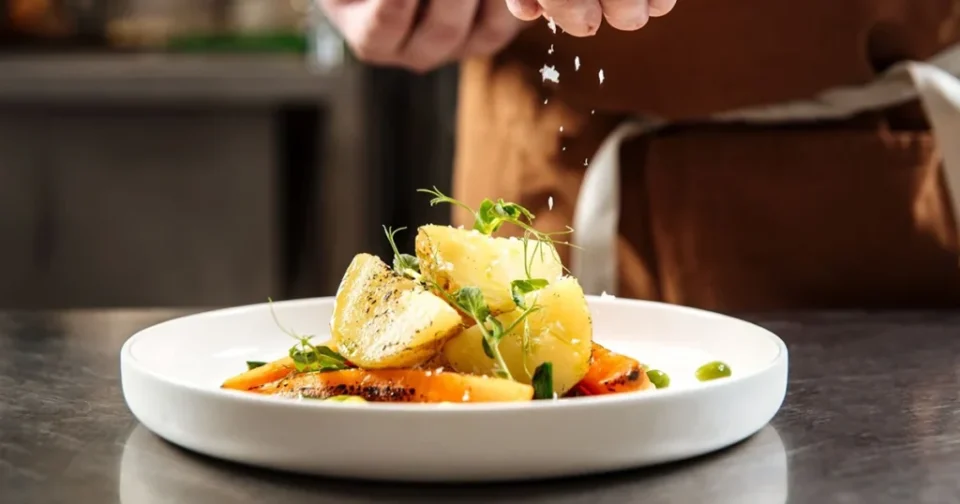
Professional kitchens rarely use standard, highly processed table salt, which has a sharp flavor and is easy to overuse. Instead, chefs prefer kosher salt for general cooking because its coarse flakes are easy to pinch, measure, and distribute evenly by hand. For finishing a dish, they use flaky sea salt, which adds a clean flavor and a delicate, crunchy texture to seared meats or roasted vegetables just before they are served.
Pre-Salting Proteins for Optimal Textures
Salting meat, poultry, or fish well in advance of cooking completely changes the protein structure. When salt is applied to a steak hours before cooking, it dissolves into the surface moisture, creates a brine, and is reabsorbed deep into the muscle fibers. This seasons the meat thoroughly and breaks down tough proteins, resulting in a significantly juicier and more tender finished product.
Harnessing High Heat and the Maillard Reaction
A widespread mistake in home kitchens is cooking food over low or medium heat out of fear of burning it. Professional chefs understand that high heat is necessary to achieve the deep flavors, complex aromas, and beautiful golden-brown colors associated with restaurant dining.
This transformation is driven by the Maillard reaction, a chemical reaction between amino acids and reducing sugars that occurs when food is subjected to high heat. It is what gives a seared steak its rich crust, roasted Brussels sprouts their sweet, charred edges, and a loaf of bread its golden crust.
To achieve a true restaurant sear at home, the pan must be preheated until it is incredibly hot, and the surface of the food must be completely dry. Moisture is the enemy of a sear; if a piece of meat is wet when it hits the pan, it will steam instead of sear, resulting in a grey texture and a loss of flavor.
Balancing Richness with Acid
When a home cook tastes a dish and feels that it is missing something, their instinct is often to add more salt. However, more often than not, what the dish actually requires is acid. Acid cuts through heavy fats, brightens dull flavors, and balances sweetness, acting as a crucial counterweight in flavor composition.
Professional chefs keep an assortment of acids within arm’s reach at all times. A splash of fresh lemon or lime juice can instantly transform a heavy cream sauce, a rich soup, or a piece of grilled fish.
Similarly, different types of vinegar, such as red wine vinegar, apple cider vinegar, or sherry vinegar, add complexity and brightness to glazes, braises, and marinades. If a dish tastes flat or heavy, a tiny drop of acid at the very end of cooking will wake up the entire flavor profile.
Utilizing Restaurant Butter Techniques and Homemade Stocks
The unmatched luxury and velvety mouthfeel of restaurant sauces are achieved through specific ingredient selections that home cooks often avoid out of health concerns or convenience.
Mounting with Butter
A classic French technique known as monter au beurre involves whisking cold cubes of unsalted butter into a hot, reduced pan sauce right after it is removed from the heat source. The cold butter emulsifies smoothly into the liquid instead of melting into separate oil and milk solids. This results in a glossy, thick, and luxurious sauce that coats the back of a spoon perfectly.
The Superiority of Real Stock
Restaurants rarely use store-bought, carton-packaged broths, which are often mostly water, salt, and artificial flavorings. Instead, they constantly simmer large pots of homemade bone stocks.
Homemade chicken, beef, or vegetable stocks are packed with natural gelatin extracted from bones during long cooking processes. This gelatin provides a rich body, a natural thickness, and a deep savory complexity that forms the perfect foundation for soups, stews, risottos, and pan glazes.
Elevating Presentation Through Texture and Knife Work
A restaurant-quality experience requires satisfying the eyes and the teeth just as much as the tongue. Professional chefs pay strict attention to structural contrast and uniform presentation.
-
Consistent Knife Cuts: Cutting vegetables and proteins into identical, uniform sizes is not just about aesthetics. When every piece of food is the exact same size, they cook at the exact same rate, preventing some pieces from turning to mush while others remain raw.
-
Textural Contrast: Great dishes incorporate multiple textures to keep the palate engaged. Chefs consciously build plates that feature a balance of crunchy, creamy, soft, and crisp elements, such as adding toasted nuts to a soft grain salad or a crisp crackling skin to a tender piece of pork belly.
-
Resting Proteins Properly: Cutting into a steak or a roasted chicken immediately after it leaves the heat causes all the internal juices to rush out onto the cutting board, leaving the meat dry. Resting the protein for five to fifteen minutes allows the muscle fibers to relax and reabsorb the moisture, keeping the meat perfectly succulent.
Frequently Asked Questions
Why do restaurant vegetables always taste better and look brighter than home-cooked ones?
Restaurants frequently use a technique called blanching and shocking to prepare vegetables. They boil the vegetables in heavily salted water for a very brief period until they are tender-crisp, then immediately submerge them into an ice bath to stop the cooking process instantly. This locks in a vibrant green color and crisp texture. The vegetables are then quickly reheated in a pan with butter or garlic right before serving.
How do professional chefs prevent garlic from burning and turning bitter in a hot pan?
Garlic contains a high amount of natural sugars and very little water, meaning it burns incredibly fast over direct heat. Chefs avoid adding minced garlic to a hot pan at the beginning of a dish. Instead, they add it during the last sixty seconds of sautéing, or they infuse whole, smashed cloves into the oil at a lower temperature and remove them before cranking up the heat for the remaining ingredients.
What is pan deglazing and how does it improve home-cooked sauces?
When meat or vegetables are seared in a pan, they leave behind caramelized, browned bits stuck to the bottom, known as the fond. Chefs never wash this away; instead, they deglaze the pan by pouring in a liquid like wine, stock, or vinegar while scraping the bottom with a wooden spoon. The liquid dissolves the fond, incorporating all that highly concentrated, deeply savory flavor directly into the base of the sauce.
Why is an expensive non-stick pan not always the best choice for cooking restaurant-quality meals?
While non-stick pans are excellent for delicate items like eggs or fish, their slick coatings actually prevent food from sticking slightly, which inhibits the formation of the fond necessary for deep flavor development. For searing meats, poultry, and hearty vegetables, professional chefs rely heavily on stainless steel, cast iron, or carbon steel pans because they retain high heat efficiently and promote superior browning.
How can a home cook determine if meat is perfectly cooked without cutting into it?
Cutting into a piece of meat to check its interior color ruins the presentation and releases the internal juices. Chefs rely on tactile memory, using the palm of their hand to judge firmness, or they use a digital instant-read thermometer. Inserting a thermometer into the thickest part of the meat gives an exact temperature reading, which is the most reliable way to guarantee perfect doneness without guesswork.
What is the secret to getting a perfectly crisp skin on fish fillets?
Achieving a crispy fish skin requires three steps: ensuring the skin is completely dry by scraping it with a knife and patting it with a paper towel, salting it right before it hits the pan, and pressing down firmly on the fillet with a spatula for the first thirty seconds of cooking. Pressing prevents the fish from curling upward, ensuring continuous, even contact between the skin and the hot pan surface.
Why do chefs prefer unsalted butter over salted butter for everyday cooking?
Unsalted butter gives the cook total control over the seasoning of a dish. Different brands of salted butter contain varying amounts of sodium, making it difficult to measure salt accurately. By using unsalted butter for cooking and baking, a chef can adjust the salt content precisely according to the specific needs of the recipe without accidentally making the food overly salty.